Free Shipping on all orders over 999 Pkr.
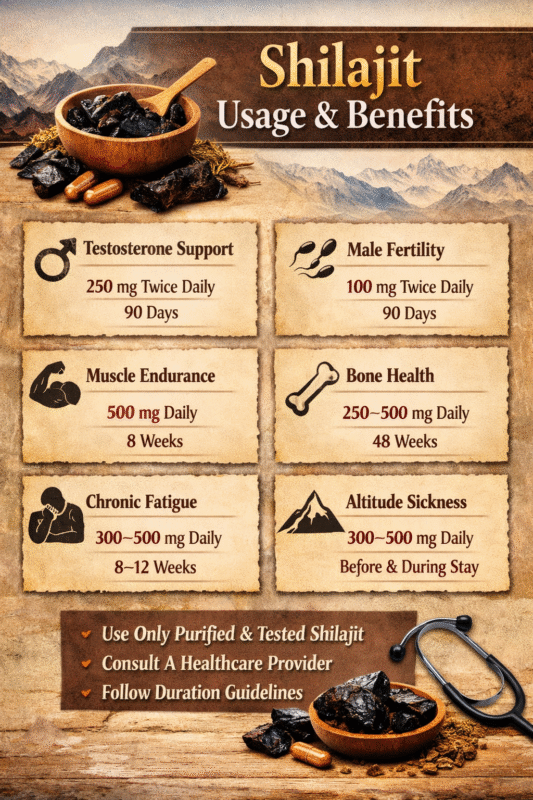
Shilajit is a natural mineral resin traditionally used in Ayurveda and other ancient healing systems to support energy, stamina, immunity, and overall wellness. It is most commonly consumed by dissolving a pea-sized amount (300–500 mg) in warm water, milk, or tea once daily, preferably in the morning on an empty stomach. Quality and purification are essential because impurities can contain dangerous heavy metals.
Summary – Quick Dosage Chart
| Condition | Dose | Duration |
|---|---|---|
| Testosterone support | 250 mg twice daily | 90 days |
| Male fertility | 100 mg twice daily | 90 days |
| Fatigue & muscle endurance | 500 mg daily | 8 weeks |
| Bone density | 250–500 mg daily | 48 weeks |
| Chronic fatigue | 300–500 mg daily | 8–12 weeks |
| Altitude sickness | 300–500 mg daily | Pre + during exposure |
Detailed, Condition-Specific Clinical Usage Instructions For Shilajit
Below are detailed, condition-specific clinical usage instructions for Shilajit based on published human studies and evidence. Each section includes clinical outcomes, study details, and suggested usage with references to source materials.
Testosterone Levels & Male Hormonal Balance
Clinical Evidence
A randomized, double-blind, placebo-controlled clinical trial in men aged 45–55 years evaluated purified Shilajit (250 mg twice daily). After 90 days, total testosterone, free testosterone, and DHEAS levels were significantly increased compared to placebo (p < 0.05). LH and FSH hormone levels remained stable, indicating hormonal balance without disruption of the reproductive axis. PubMed
Outcomes
- Significant rise in total and free testosterone
- Increase in DHEAS (precursor to testosterone)
- No adverse effects on gonadotropic hormones
Suggested Usage
💡 Dose: 250 mg twice daily
💡 Duration: 90 days
💡 Best Taken: With meals to improve absorption.
This regimen was associated with improved male androgenic hormone levels in middle-aged healthy men. PubMed
Sperm Quality & Male Fertility
Clinical Evidence
In a randomized clinical study involving oligospermic men, processed Shilajit at 100 mg twice daily for 90 days significantly improved semen parameters:
- Total sperm count: +61.4%
- Sperm motility: +~17%
- Normal sperm morphology: +~19%
- Reduction in oxidative stress marker (MDA)
- Increase in serum testosterone (+23.5%)
These results demonstrate improved spermatogenesis and semen quality. PubMed
Suggested Usage
💡 Dose: 100 mg twice daily
💡 Duration: 90 days
💡 Note: This protocol was tested in men with low sperm count and may support fertility improvements. PubMed
Physical Fatigue & Muscle Endurance
Clinical Evidence
A double-blind, placebo-controlled trial investigated Shilajit supplementation at 250 mg/day and 500 mg/day for 8 weeks in healthy adults. At 500 mg/day, participants showed:
- Less decline in maximal muscular strength after exertion
- Lower serum hydroxyproline (HYP) levels—a marker of muscle/collagen breakdown
indicating improved resistance to fatigue and connective tissue support. PMC
Suggested Usage
💡 Dose: 500 mg daily
💡 Duration: 8 weeks
💡 With food: For improved tolerance.
This dosing was linked to better muscle endurance and less fatigue-related decline after physical performance challenges. PMC
Bone Density & Osteopenia
Clinical Evidence
In a 48-week randomized controlled trial on postmenopausal women with early bone loss, daily supplementation with 250 mg or 500 mg of a standardized Shilajit extract improved bone mineral density and reduced biomarkers of bone turnover, oxidative stress, and inflammation. Shilajit Research Journal
Suggested Usage
💡 Dose: 250–500 mg daily
💡 Duration: 48 weeks (long-term)
Supports bone mineral health in postmenopausal women at risk of osteopenia/osteoporosis. Shilajit Research Journal
Chronic Fatigue & Energy Metabolism
Clinical/Research Observations
Clinical studies summarized in systematic reviews and trials suggest that Shilajit supplementation reduces symptoms of chronic fatigue and may enhance mitochondrial energy production due to its fulvic acid and antioxidant content. Dose ranges in human studies were 300–500 mg/day for durations up to several months. JPTCP
Suggested Usage
💡 Dose: 300–500 mg daily
💡 Duration: 8–12 weeks or longer
Useful for individuals experiencing prolonged tiredness due to metabolic or mitochondrial factors. JPTCP
High-Altitude Sickness and Acclimatization
Clinical Observations
Systematic reviews report that Shilajit has been shown in human and traditional studies to reduce symptoms of high-altitude sickness, including headache, nausea, and fatigue at high elevations. Doses used clinically ranged from 300 mg to 500 mg daily, generally begun before ascent and continued during exposure. JPTCP
Suggested Usage
💡 Dose: 300–500 mg daily
💡 Timing: Start 3–7 days before high-altitude exposure; continue for the duration of stay.
This approach may help reduce acute mountain-related symptoms. JPTCP
Important Usage Notes (General)
- ✅ Only use purified, lab-tested Shilajit resin or standardized extract to avoid heavy metal contamination and impurities.
- ✅ Most clinical effects were observed with daily usage for extended periods (8 weeks to 3 months or more).
- ✅ Start with lower dosages and increase only if tolerated.
- ✅ Consult a healthcare provider, especially if taking medications or having pre-existing conditions.
Key Takeaways
📌 Traditional & Modern Uses: Energy, cognitive support, hormonal balance, immunity, bone health.
📌 Main Active Components: Fulvic acid, trace minerals, antioxidants.
📌 Scientific Evidence: Promising but still limited—many benefits need larger, high-quality human trials.
📌 Safety: Purification and reputable sourcing matter most.
Safety & Precautions
⚠️ While shilajit is generally considered safe when purified properly, safety is NOT guaranteed without quality control:
- Heavy metal contamination (e.g., arsenic, lead) has been reported in untested products.
- Rare allergic reactions (anaphylaxis) are possible.
- Pregnant or breastfeeding individuals should avoid it unless advised by a physician.
👉 Always choose brands with third-party testing certificates and consult a healthcare professional before starting supplements.